The Jackpot Illusion: Why Most Opportunities Don’t Come Twice
Ujunwoye on 19 March, 2026 | No Comments
The Idea That Stays With Me
Opportunities don’t come twice?
My friend, Oo Nwoye once told me something that sits with me every single day.
In life, some people are lucky enough to hit a jackpot.
It isn’t always what we think. It’s rarely a lottery win or sudden wealth. More often, it looks like a life-changing idea, a career-defining growth window, or one of those “right place, right time” moments that quietly reshapes everything.
The kind of moment that, if you trace your life backward years later, you realize: that was it. That was the hinge. The turning point. The door that led to everything else.
And yet, most people miss it, not because they didn’t see it, but because they misunderstood it.
The Myth of Infinite Opportunities
We’ve been conditioned to believe something comforting, almost soothing.
That life has an infinite runway.
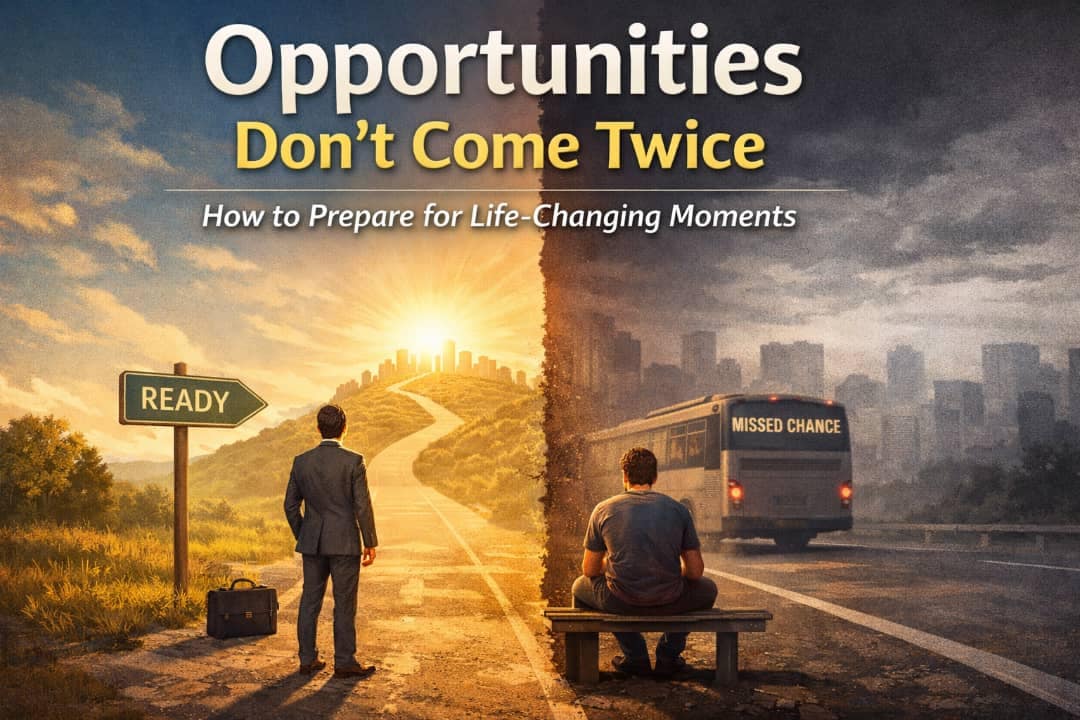
That opportunities are like city buses, if you miss one, another will come along in a few minutes.
So we delay.
We hesitate, procrastinate and we assume we’ll be “more ready next time.”
But here’s the uncomfortable truth:
For most people, the bus only runs once.
Not because opportunities are rare in a literal sense, but because the specific alignment of timing, access, relationships, and readiness that creates a jackpot moment is incredibly rare.
It’s not just the opportunity itself.
It’s the context around it.
The people you know at that moment.
The skills you’ve built (or haven’t).
The reputation you carry into the room.
The mental and emotional state you’re in.
All of these variables rarely align twice in the exact same way.
So while life may offer many chances, the same chance, the one that could have changed everything, often doesn’t repeat.
The Reality: Opportunities don’t come twice, yes, they don’t repeat themselves
We tend to romanticize opportunity. We expect it to arrive loudly, dramatically, with clear signals.
But real jackpot moments are often quiet.
They look like:
- A conversation that could lead to a partnership
- A small project that has outsized future potential
- A job offer that doesn’t pay much now but opens powerful doors later
- A chance meeting with someone who could change your trajectory
- An idea that feels risky but has asymmetric upside
Most people miss these moments because they don’t feel like jackpots.
They feel inconvenient, uncertain or like extra work.
And that’s the trap.
When the Moment Hits: Two Types of People (Planners vs storytellers)
When a jackpot moment appears, the world quietly splits into two groups:
1. The Planners
The Planners are not necessarily smarter.
They’re not always more talented or even always more hardworking.
But they have something most people don’t:
Infrastructure.
They’ve spent time building:
- Skills that compound
- Relationships that matter
- Systems that support growth
- A reputation that opens doors
So when opportunity shows up, they don’t scramble.
They plug it in.
They know how to extract value from the moment because they’ve been preparing, intentionally or not, for something like it.
To them, luck is not something to admire.
It’s something to deploy.
They turn a moment into a platform.
2. The Storytellers
Then there are the Storytellers.
These are the people who encounter the same opportunities but aren’t ready for them.
Not because they’re incapable, but because they haven’t built the foundation required to sustain or multiply the moment.
So what happens?
They consume the opportunity instead of investing it.
They enjoy the moment, participate in it and may even benefit from it in the short term.
But they don’t convert it into something lasting.
And over time, that moment becomes a story.
- “I was once in the room with…”
- “I almost worked on…”
- “I had the chance to…”
Their lives become a collection of near-misses and almost had it.
Not because they were unlucky.
But because they weren’t prepared to hold the luck when it came.
Why Most People Default to Storytellers
It’s easy to assume that people who miss opportunities are careless or lazy.
But the reality is more nuanced.
Most people default to being Storytellers because of three subtle patterns:
1. They Underestimate the Moment
When something feels small, we treat it casually.
We don’t realize that small doors often lead to big rooms.
So we delay action.
We don’t give our best.
And we treat it as though its optional.
By the time we realize its importance, the window has closed.
2. They Overestimate Future Chances
We tell ourselves comforting lies:
- “Another opportunity will come.”
- “I’ll be more ready next time.”
- “This isn’t the only shot.”
But what we don’t realize is that future opportunities often require proof from past ones.
And if you didn’t maximize the first, you may never qualify for the second.
3. They Lack Transferable Capital
Opportunities don’t exist in isolation.
They connect.
One leads to another, but only if you extract something from it.
That “something” is what I like to call capital.
The Three Forms of Capital That Buy You Second Chances
Second chances are not free.
They are bought.
And the currency you use comes from what you did with your first opportunity.
There are three main types:
1. Social Capital
Who knows you?
Who trusts you?
Who is willing to vouch for you?
If you maximize a moment, people remember.
They recommend you, bring you into new rooms and attach their reputation to yours.
But if you waste the moment, you don’t just lose the opportunity, you lose credibility.
2. Financial Capital
Did the opportunity create resources you can reinvest?
Money gives you optionality.
It allows you to:
- Take risks
- Buy time
- Access better environments
But if you consume everything you earn from a lucky break, you lose the ability to re-enter the game at a higher level.
3. Intellectual Capital
What did you learn?
Skills.
Insights.
Experience.
Even if an opportunity doesn’t pay well or expand your network, it can still build knowledge that compounds.
But only if you approach it intentionally.
The Real Cost of Squandering Your Jackpot
When you miss a jackpot moment, the loss isn’t just immediate.
It compounds over time.
You lose:
- The downstream opportunities it would have unlocked
- The relationships that would have formed
- The skills you would have developed under pressure
- The credibility that would have followed success
And perhaps most importantly:
You lose access.
Because the rooms where big bets are made don’t stay open forever.
They open for those who have proven they can handle what’s inside.
Why Timing Is More Fragile Than We Admit
There’s another layer to this that we don’t talk about enough:
Timing is fragile.
You may meet the same person again, but not when they’re in a position to help.
You may get the same idea but the market may not be ready for it.
You may find the same opportunity the unfortunately, the same energy, freedom, or support may elude you.
We assume life is cyclical.
But in reality, it’s more like a series of windows that open and close.
And once a window shuts, the next one is not the same window.
Building Your “Infrastructure” Before the Moment Comes
If the difference between Planners and Storytellers is preparation, then the obvious question becomes:
How do you prepare for something you can’t predict?
You build infrastructure.
Not for a specific opportunity but for any opportunity.
1. Build Skills That Compound
Focus on abilities that increase in value over time:
- Communication
- Writing
- Strategic thinking
- Problem-solving
- Relationship management
These are skills that make you useful in almost any room.
2. Create Visible Proof of Work
Don’t just learn, show.
- Share your ideas
- Document your process
- Publish your work
Opportunities often come to people who are visible, not just capable.
3. Invest in Relationships Early
Don’t wait until you need people to connect with them.
Build genuine relationships over time.
Because when opportunity comes, it often travels through people, not platforms.
4. Develop a Bias for Action
When something appears, move.
Not recklessly but decisively.
Speed matters more than perfection in most opportunity windows.
5. Learn to Recognize Asymmetric Opportunities
Not all opportunities are equal.
Some have limited downside but massive upside.
Train yourself to identify these and prioritize them.
The Subtle Discipline of Not Consuming Your Luck
One of the hardest things to do when you encounter a jackpot is this:
Not to consume it.
Because it’s tempting.
To celebrate, relax and enjoy the moment fully.
And there’s nothing wrong with that until it becomes the only thing you do.
The real discipline is asking:
- How do I turn this into something that lasts?
- What can I extract from this beyond the immediate benefit?
- How do I use this to access the next level?
That shift from consumption to investment is what separates trajectories.
A Different Way to Think About Luck
We often think of luck as random.
And to some extent, it is.
But there’s another layer; luck favours those who are positioned to use it.
Two people can encounter the same opportunity.
One builds a life from it.
The other builds a story.
The difference is rarely the opportunity itself.
It’s the preparation behind it.
Why This Stays on My Mind Every Day
I think about this every day because it changes how you approach everything.
You start to:
- Take small opportunities more seriously
- Prepare even when there’s no immediate reward
- Treat relationships with more intention
- Move faster when something feels right
- Focus less on waiting and more on building
You stop assuming there will be another bus.
And you start preparing as if this might be the only one.
Final Thoughts: Don’t Just Be There Be Ready
Life doesn’t always give clear warnings before it changes.
There’s no announcement.
No countdown and no guarantee.
Just a moment.
A door, conversation and an idea.
And in that moment, you won’t rise to your hopes.
You’ll fall to your level of preparation.
So, the real question isn’t:
“Will I get another chance?”
It’s: “If the moment comes today, am I ready to turn it into something that lasts?”
Because the difference between a life defined by outcomes and one defined by stories is often just this:
What you did when luck found you.